
Expect to submit an INDAlso known as an IND or IND application. Companies like Intellia submit an IND to begin testing of investigational therapies in humans in the U.S. An IND is equivalent to a CTA, the regulatory application required in many countries outside the U.S. to begin clinical testing. or IND-equivalent in mid-2021 for NTLA-5001
Our first ex vivoAlso referred to as a cell therapy. In an ex vivo therapy, cells are removed from the body for modification. Modification is done by administering therapy directly to the cells before they are returned to the body. In the case of ex vivo CRISPR/Cas9 therapies, CRISPR/Cas9 is used to modify the extracted cells to repair them back to their proper function or add desired functions. The engineered cells are then administered to the patient so they can treat a particular disease. development candidate seeks to treat acute myeloid leukemiaAlso known as AML. Cancer of the blood and bone marrow that is rapidly fatal without immediate treatment, and is the most common type of acute leukemia in adults. (AMLAlso known as AML. Cancer of the blood and bone marrow that is rapidly fatal without immediate treatment, and is the most common type of acute leukemia in adults.) by engineering autologousCell therapy created by genetically modifying a patient’s own immune cells ex vivo (or outside the patient’s body) to restore their function or add therapeutic properties, for example, to target specific cancer cells. After modification, cells are produced in large quantities and administered to the patient. T cell receptors (TCR)Antigen receptor found on the T cell membrane that can efficiently recognize antigens that arise on the surface of a cell or from within a cell. NTLA-5001, which is Intellia’s first investigational engineered T cell therapy and is wholly owned, utilizes a TCR-directed approach to target the WT1 intracellular antigen for the treatment of AML. directed towards the Wilms’ Tumor 1Also known as WT1. Protein that in most AML cells and also in a variety of solid tumors is expressed at levels high above normal expression levels. This overexpression makes WT1 an attractive tumor target. NTLA-5001 utilizes a TCR-directed approach to target the WT1 intracellular antigen for the treatment of AML. (WT1Also known as WT1. Protein that in most AML cells and also in a variety of solid tumors is expressed at levels high above normal expression levels. This overexpression makes WT1 an attractive tumor target. NTLA-5001 utilizes a TCR-directed approach to target the WT1 intracellular antigen for the treatment of AML.) antigenAntigens are unique to different pathogens, which include viruses, fungi and abnormal cells such as tumor cells. Antigens alert the immune system to foreign substances not recognized by the body, leading to immune responses like destruction of abnormal cells or production of antibodies., an over-expressed protein that is often associated with AML and other cancers. We have nominated NTLA-5001 as our initial development candidate for AML and expect to enter the clinic in 2021. Intellia’s lead WT1 TCRAntigen receptor found on the T cell membrane that can efficiently recognize antigens that arise on the surface of a cell or from within a cell. NTLA-5001, which is Intellia’s first investigational engineered T cell therapy and is wholly owned, utilizes a TCR-directed approach to target the WT1 intracellular antigen for the treatment of AML. also has the potential to target WT1-positive solid tumorsRefers to tumors that are solid, vs. liquid, in cancers such as ovarian cancer, glioblastoma, lung cancer and mesothelioma. These are examples of cancers that Intellia’s lead WT1 TCR may have the potential to target., such as ovarian cancer, glioblastoma, lung cancer and mesothelioma.

Aside from our proprietary programs, our partnered ex vivo programs with Novartis focus on chimeric antigen receptorCAR-T cell stands for chimeric antigen receptor (CAR) T cell therapy. This therapy type modifies immune cells (T cells) to express a receptor on their surface that recognizes and binds to molecules (antigens) on the surface of malignant or cancerous cells. Once the receptor binds to a tumor antigen, the T cell is activated to attack the malignant cells. T cellsType of white blood cell, or leukocyte, essential to the immune system. Intellia is engineering T cells against specific cancer antigens. (CAR-TCAR-T cell stands for chimeric antigen receptor (CAR) T cell therapy. This therapy type modifies immune cells (T cells) to express a receptor on their surface that recognizes and binds to molecules (antigens) on the surface of malignant or cancerous cells. Once the receptor binds to a tumor antigen, the T cell is activated to attack the malignant cells. cells) and hematopoietic stem cells (HSCs). In March 2020, the U.S. Food and Drug Administration accepted the Investigational New Drug (IND) applicationAlso known as an IND or IND application. Companies like Intellia submit an IND to begin testing of investigational therapies in humans in the U.S. An IND is equivalent to a CTA, the regulatory application required in many countries outside the U.S. to begin clinical testing. submitted by Novartis for a CRISPR/Cas9-based engineered cell therapyType of therapy where engineered cells are transferred into a patient’s body to grow, replace or repair damaged tissue, or perform another desired function. Cells used in these therapies may originate from the patient (autologous cells) or from a donor (allogeneic cells). A common type of cell therapy is blood transfusions, where red blood cells, white blood cells and platelets from one or more donors are transferred into the body of a patient. for the treatment of sickle cell disease (SCD). OTQ923 is a SCD treatment based on genome editingAlso called gene editing. Genome editing collectively refers to a set of technologies, including CRISPR/Cas9, that can be used to cut and modify DNA. Genome editing uses systems to make the DNA change inside the cell. These cells can be edited in the body (in vivo) or outside the body (ex vivo) from a patient or donor. of HSCs, using CRISPR/Cas9Adapted from a naturally occurring bacterial immune system, CRISPR is an acronym for Clustered Regularly Interspaced Short Palindromic Repeats. One of the proteins in the CRISPR system is known as CRISPR-associated 9 protein or Cas9 protein, which acts as a pair of ‘molecular scissors’ to cleave DNA. Researchers have co-opted the bacterial CRISPR/Cas9 system to make specific changes in the DNA of humans, other animals and plants. CRISPR/Cas9 was first harnessed in 2012 as a genome editing tool in the lab. More recently, scientists have begun engineering and testing CRISPR systems to be very specific to a desired genetic target. RNA guides identified through Intellia’s cell therapy research collaboration with Novartis.
CRISPR/Cas9 Improves Engineered Cell Therapies for Cancer
We are using CRISPR/Cas9 to selectively and precisely edit the genes of patients’ immune cells, with the goal of improving their performance in treating oncological and immunological diseases. These improved immune cells should more effectively identify and attack cancerous cells upon re-infusion. There is much opportunity to improve the treatment of cancer by using CRISPR with TCR-specific approaches.

We seek to leverage CRISPR/Cas9 genomeA genome is an organism’s complete set of DNA, including all of its genes. Each genome contains all of the information needed to build and maintain that organism. In humans, a copy of the entire genome—more than three billion DNA base pairs—is contained in all cells that have a nucleus. editing to create next-generation engineered cells that can treat oncological and immunological diseases for which there are currently limited to no treatment options available. While current cell therapiesType of therapy where engineered cells are transferred into a patient’s body to grow, replace or repair damaged tissue, or perform another desired function. Cells used in these therapies may originate from the patient (autologous cells) or from a donor (allogeneic cells). A common type of cell therapy is blood transfusions, where red blood cells, white blood cells and platelets from one or more donors are transferred into the body of a patient. have improved the standard of care, they are currently restricted to very limited indications. These first-generation cell therapies are also cumbersome and expensive to deliver to patients and may be unavailable to patients who don’t have a healthy enough immune system.
We envision patients completing a single visit to the clinic for administration of an off-the-shelf (i.e., allogeneicCell therapy comprising immune cells collected from healthy donors, rather than the patient, and then modified ex vivo (or outside the donors or patient’s bodies) to restore their function or add therapeutic properties, for example, to target specific cancer cells. After modification, cells are administered to the patient.) cellular medicine. By applying CRISPR/Cas9 to human cells, we intend to pre-manufacture allogeneic-based cellular therapies, which would be engineered to target tumor-specific markers. This platform would potentially allow these therapies to address many hematological and solid cancers, therefore, representing a truly allogeneicCell therapy comprising immune cells collected from healthy donors, rather than the patient, and then modified ex vivo (or outside the donors or patient’s bodies) to restore their function or add therapeutic properties, for example, to target specific cancer cells. After modification, cells are administered to the patient. solution for patients.
CRISPR/Cas9 Engineered Cell Approaches for Cancer Treatment

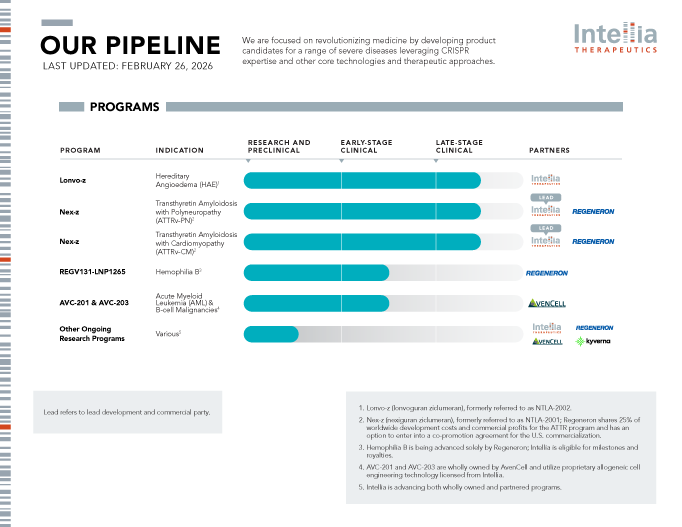
To keep up with our progress, check out our pipeline.